


Clean Industrial Deal call – alternative to Innovation fund
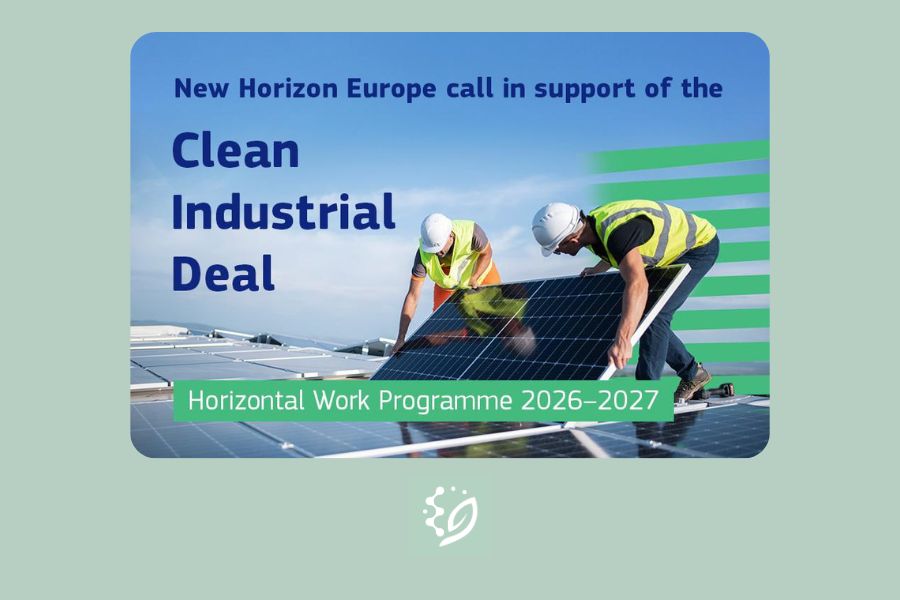
New type of Horizon Europe funding – Clean Industrial Deal call for industrial pilots (TRL 7–8) aimed at accelerating the deployment of advanced technologies for decarbonising energy-intensive industries and the commercialisation of clean technologies.
In the 2026–2027 period, €540 million will be allocated to the call, of which €275 million in 2026. Individual projects may receive between €15 million and €25 million, with approximately 30 industrial pilot projects expected to be funded.
The first deadline for proposal submission is 15 September 2026.
KEY INFORMATION
- The call targets pilots that are ready for investment
- The consortium must cover the entire value chain; 5–10 partners are sufficient
- Complementarity of expertise and coherence of partners are more important than consortium size
- Eligible costs include engineering, equipment, and OPEX
- Funding rate: 70%
The European Commission will assess the technical plan, techno-economic assessment, business plan, market plan, and required permits before approving full implementation of the pilot project.
CONSORTIUM STRUCTURE
- Industrial company that will own or operate the plant
- Technology developer(s) (one or more, if the solution includes multiple modules)
- Technical partners, such as:
- technology centres and universities (involved in earlier development phases and/or contributing to process optimisation)
- providers of specialised expertise (digitalisation, energy efficiency, process integration, etc.)
- scale-up experts (from pilot to demonstration)
- End customer or user who will test the solution under real operating conditions
- Strategic partners, such as:
- communication and dissemination specialists
- certification and regulatory experts
- LCA consultants
- biodiversity or social acceptance experts
(depending on the business model and market conditions)
PROJECT BUDGET
- Engineering
Engineering companies do not necessarily need to be consortium partners; they may act as subcontractors or service providers depending on scope. - Equipment
Only depreciation during the project duration is eligible, in line with company accounting rules.
Example: if accelerated depreciation is 5 years and the project runs for 3 years, 60% of equipment costs can be claimed. - OPEX
Raw materials, electricity, fuels, and consumables are eligible if clearly identifiable and directly linked to project implementation. - Personnel costs
For staff assigned to the project. - Other costs
Travel, audit, laboratory testing, and minor goods and services.
TWO THEMATIC PILLARS
Decarbonisation of Energy-Intensive Industry
- CO₂ circularity (CCU / CCUS)
- Use of clean technologies in production
- Circular economy
Clean Technologies for Climate
- Integrated low-carbon energy systems
- Advanced zero-emission technologies
- Storage technologies, renewable gases, and CCU
An additional 25% flat rate is added to eligible direct costs to cover indirect costs.
During implementation, profits generated from demonstration activities are eligible, provided that the sum of the grant and the profit does not exceed the total eligible budget.
Link to the clean technologies call
Link to the decarbonisation call
For more information about the call, contact: nina.meglic@act-si.org.
We can support you with proposal preparation and participate as a partner for LCA, communication and dissemination, and ensuring social acceptance of technologies.